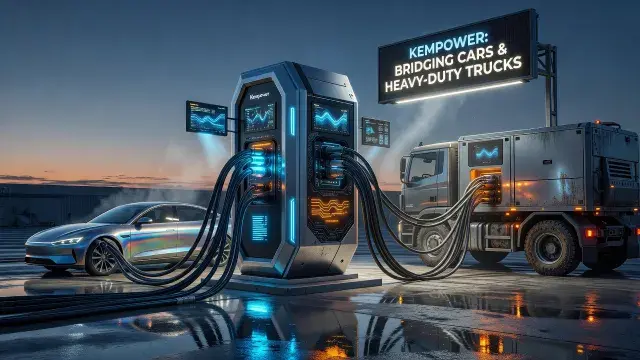
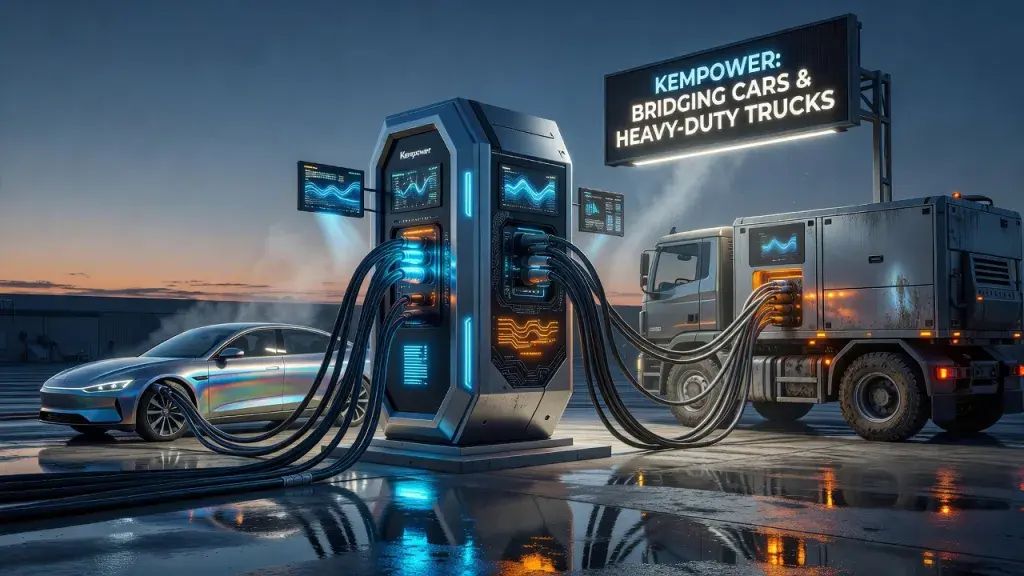
A single piece of hardware that can charge both a passenger sedan and an electric long-haul truck sounds modest until you consider what it saves: land, cabling, permitting time, and months of construction. Kempower has unveiled the Mega Satellite Flex, a high-power dispenser that supports the established CCS standard at up to 560 kW and the emerging Megawatt Charging System at up to 1.2 MW, making it the Finnish manufacturer's first unit built to serve both standards from a single cabinet.
The announcement lands at a pivotal moment for commercial charging infrastructure. CCS remains the dominant connector for electric cars across North America and Europe, but it was never designed for the power demands of an electric semi truck that needs to recharge in the time it takes a driver to take a mandated rest break. MCS was developed specifically for that use case, and its rollout is still in early stages, with vehicle manufacturers and charging companies working through interoperability testing. For network operators trying to plan sites years in advance, the uncertainty over which standard will need to be supported, and when, has been a genuine obstacle - not unlike the way consumers weighing privacy tools have to compare something like a BuyBestVPN server network against competing options before committing to infrastructure they hope will still make sense in a few years.
One Site, Two Standards
The practical case for the Mega Satellite Flex rests on avoiding duplicate buildouts. Historically, a site owner wanting to serve both passenger EVs and electric trucks would need to install separate dispensers, separate power runs, and often separate transformer capacity for each standard. Kempower's approach lets an operator install one unit that handles either connector type, deferring the decision about which vehicles will show up most and letting real-world demand, rather than guesswork, shape future expansion.
That flexibility extends to the emerging class of 800-volt electric vehicles, which require higher voltage delivery to hit their fastest charging speeds. As more manufacturers move to 800-volt platforms for both cars and trucks, chargers that cannot deliver those voltages become a bottleneck regardless of how much power they can technically supply. The Mega Satellite Flex is built to accommodate that shift rather than requiring a hardware swap later.
Specifications and Site Integration
On the technical side, the unit supports up to 1,500 amps for MCS charging and 700 amps for CCS, with cable lengths of 5 meters for CCS and 2.7 meters for MCS - long enough to reach the charging inlets on trucks with different cab configurations without forcing awkward parking maneuvers. An optional payment terminal allows the dispenser to serve public or mixed-fleet locations where not every driver is tied to a fleet account.
Kempower also designed the Mega Satellite Flex to work with its existing distributed charging architecture, meaning operators who already run Kempower power cabinets and satellite units can add the new dispenser without rebuilding their electrical distribution from the ground up. That compatibility matters commercially: retrofitting a site is expensive, and any charger that requires a parallel electrical system tends to get passed over in favor of one that plugs into what is already there.
What Comes Next
The company revealed the Mega Satellite Flex at its Unplug & Recharge event held alongside ACT Expo, where it remains on display this week. Kempower has set a North American and European launch for July 2026, giving fleet operators and charging network developers over a year to factor the unit into site planning.
The bigger story here is about risk management for infrastructure investors. Betting heavily on one charging standard before the market settles is expensive if it turns out wrong. A dispenser that hedges between CCS and MCS, while also accommodating higher-voltage vehicle platforms, gives site owners a way to build now without locking themselves into assumptions that could be outdated within a few years - a pattern familiar to anyone who has watched infrastructure decisions in fast-moving technology markets play out before.